A direct comparison of these two challenging northern routes, examining terrain, solitude levels, physical demands, accommodation availability, and the distinct
So you've done your research, scrolled through countless Instagram feeds of happy pilgrims, and decided that the Camino Francés might be a bit too... populated for your taste. Smart thinking. The northern routes offer something different—rawer, more demanding, and with a solitude that feels increasingly rare on the Way. But now you're facing another choice: the dramatic Atlantic coastline of the Camino del Norte, or the ancient mountain paths of the Camino Primitivo?
I've walked the Norte myself, and whilst I haven't personally completed the Primitivo, I've spent years collecting stories from fellow pilgrims who have, often over that communal glass of wine at the end of a long walking day. What I can offer you is honest insight from my own Norte experience combined with the accumulated wisdom of dozens of pilgrims who've walked both routes—sometimes in the same year, making direct comparisons.
Let me help you figure out which path is calling your name.
Having walked the Francés six times, I can tell you that the northern routes offer a fundamentally different experience. Not better or worse—different. The infrastructure is less forgiving, the terrain more demanding, and the pilgrim community smaller but often more tight-knit because of it.
When I walked the Norte, I quickly learned that "coastal" doesn't mean "flat." That was a humbling discovery around day three. The route constantly rises and falls as it traces the Cantabrian coastline, taking you up cliffs, down to beaches, and back up again. My legs developed an intimate relationship with those endless undulations.
The surfaces vary wildly: rocky coastal paths, paved roads through fishing villages, forest trails, and yes—some road walking that can feel tedious after the drama of sea cliffs. The highlights are spectacular: the Basque Country's rugged shoreline, Santander's elegant bay, the Asturian coast with its impossible green hills tumbling into blue water.
But go in knowing this: the Norte is long. At roughly 825 kilometers from Irún to Santiago, it's significantly more than the 780-odd kilometers of the Francés. Those extra kilometers matter when every day includes 500-1000 meters of cumulative elevation change.
The Primitivo's mountain character
The Primitivo, from everything I've gathered from fellow pilgrims, offers a different kind of difficulty. At roughly 320 kilometers from Oviedo to Santiago (or about 350 if you start from the coast and walk through Oviedo), it's much shorter—but don't let that fool you. The elevation is more concentrated and more serious.
The route crosses the Cantabrian Mountains, hitting altitudes that can reach over 1,100 meters at passes like the Alto del Acebo. Pilgrims who've walked both consistently tell me the Primitivo feels more continuously demanding—fewer flat recovery sections, more sustained climbing. One German pilgrim I met in Santiago described it as "the Pyrenees stretched over several days instead of one."
The payoff is mountain scenery that rivals anything in northern Spain: high meadows, ancient oak forests, and dramatic valleys that feel genuinely remote.
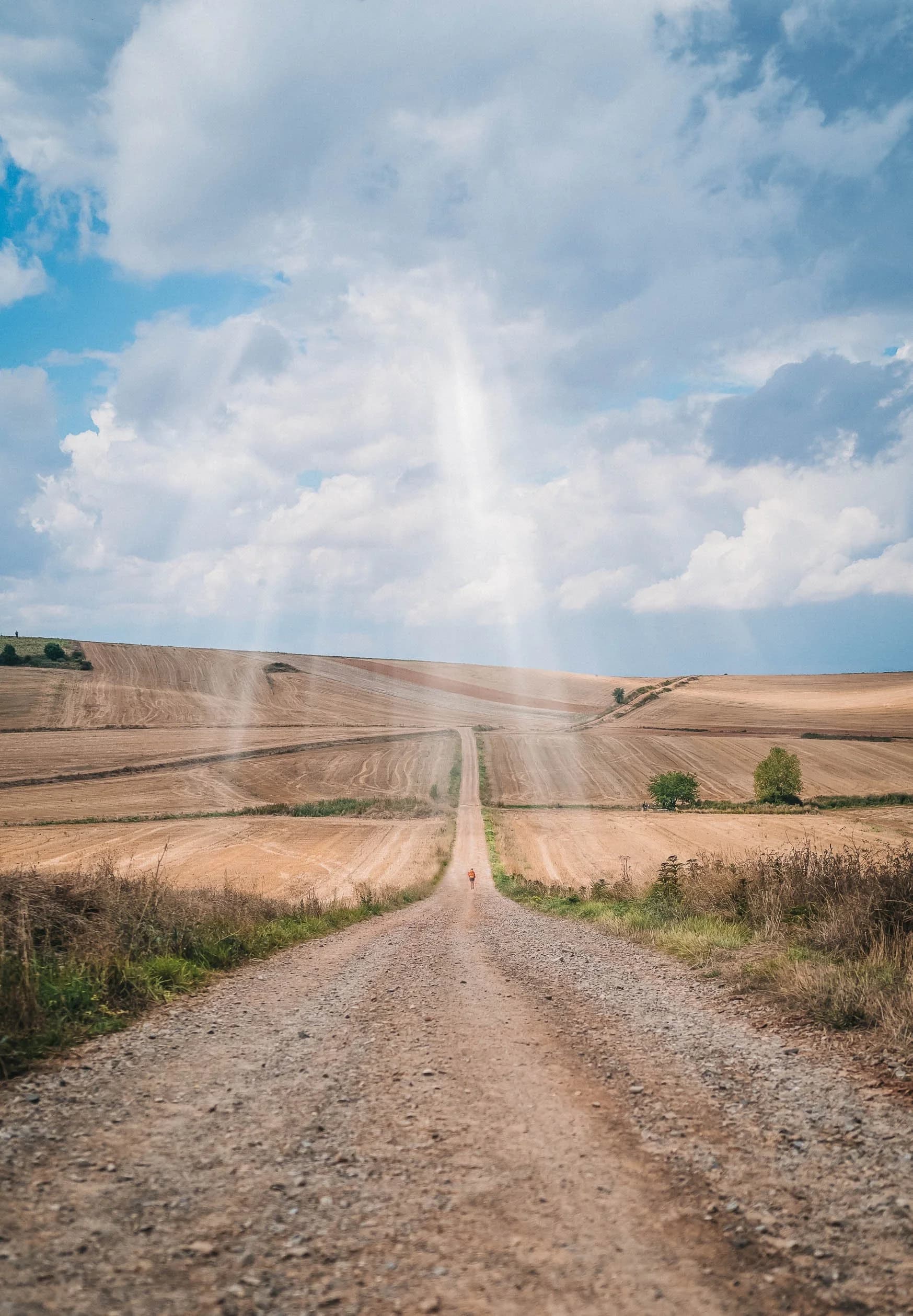
On the Norte, I experienced something I hadn't felt on my Francés walks: genuine solitude. Entire mornings where I saw no other pilgrims. Villages where the bar owner seemed surprised anyone was walking through. This changes somewhat in high season (July-August), but even then, you're talking about seeing maybe 20-30 pilgrims per day rather than the hundreds on the Francés.
The flip side? Sometimes that solitude felt isolating rather than peaceful. There were days when I craved conversation, when the internal dialogue got a bit too loud, and when I walked into a small albergue to find only two other pilgrims—one of whom went to bed at 7 PM and the other didn't speak my languages.
The Primitivo's intentional remoteness
From what I've learned from Primitivo pilgrims, the solitude there can be even more pronounced, particularly in the mountain sections before joining the Francés at Melide. The route sees perhaps 5% of the traffic of the Francés. One Australian woman I met described it perfectly: "Some days I felt like the last person on earth, and I couldn't decide if that was terrifying or exactly what I needed."
The Primitivo's quiet feels different because it comes with genuine remoteness. You're not just away from other pilgrims—you're away from villages, from shops, from easy phone signal. That requires a different psychological preparation.
The Norte broke me down gradually rather than dramatically. It wasn't any single day that destroyed me—it was the accumulation. By week three, my Achilles tendons were staging a rebellion, and my hip flexors had developed opinions about every uphill.
The repetitive nature of coastal terrain—up cliff, down to beach, up cliff, down to village—creates specific stresses. A good pair of trekking poles helped enormously. I used Leki Makalu poles which handled the rocky descents well.
Weather adds another layer. The Bay of Biscay isn't known for its clemency. I experienced driving rain, surprising heat, and fog so thick I couldn't see the next trail marker. A reliable rain jacket isn't optional—I'd recommend something breathable like the Arc'teryx Beta LT if your budget allows, or the Outdoor Research Foray for a more reasonable price.
What the Primitivo asks
Primitivo veterans consistently report that the route demands more raw climbing fitness. If you've done multi-day mountain hikes before, you'll know what I mean—the sustained ascents that test your cardiovascular system and your mental patience simultaneously.
The surfaces are generally more forgiving than the Norte's rocky coastal paths, with more earth and forest floor. But the altitude brings its own considerations: cooler temperatures even in summer, the possibility of early or late-season snow at the highest points, and potentially less reliable mobile coverage.
Every pilgrim I've spoken with who completed the Primitivo mentioned two things: stronger quads by the end, and a particular satisfaction that comes from sustained mountain effort.
The Norte's infrastructure is better than it was even five years ago, but it remains inconsistent. Major towns like San Sebastián, Bilbao, Santander, and Gijón have multiple options—municipal albergues, private hostels, pensiones. But some smaller coastal villages have exactly one place to stay, and if it's full or closed, you're facing an extra 10 kilometers.
I learned to call ahead or arrive early in smaller villages. That said, the Norte's accommodation variety is a blessing if you occasionally want a private room to recover. The route passes through genuine cities where you can find anything from a hostel bunk to a boutique hotel.
The food, when you find it, is exceptional. Basque pintxos haunted my dreams for months afterward. Asturian cider poured from height. Galician seafood as you near Santiago. The Norte might be the most culinarily rewarding Camino route—if you're willing to pay a bit more and seek out the good spots.
Primitivo accommodations: simpler but intimate
The Primitivo has fewer options, period. Pilgrims describe smaller albergues, often converted farmhouses or village buildings with limited beds. This creates an intimacy that some find beautiful—you eat dinner with the same five people you've been walking near for three days—and others find claustrophobic.
The smaller pilgrim numbers mean availability is less of an issue in most places, but the total number of beds is lower too. In high season, the math can still get tight.
Food on the Primitivo tends toward simple, hearty mountain fare. Pilgrims praise the Asturian fabada (bean stew), the roast meats, the potatoes done a dozen ways. It's not the variety of the Norte's coastal cities, but it's satisfying after a day of climbing.
On the Norte, my experience was one of expansion—the horizon, the vast Atlantic, the sense of following the edge of a continent. The openness invited big-picture thinking. What do I want from this life? What patterns keep repeating? The sea provides no answers, but it provides space for questions.
Pilgrims returning from the Primitivo describe something different—a journey inward. The mountains enclose. The forest paths limit your view to what's immediately ahead. Progress comes step by step, not in sweeping coastal panoramas. Several people have told me the Primitivo felt more overtly spiritual, more connected to the original medieval pilgrimage energy. King Alfonso II first walked this route in the 9th century, after all.
Neither quality is superior. But your own needs might align more with one or the other. Ask yourself: do you need to see far, or do you need to focus close?
The Norte takes most pilgrims 35-40 walking days. The Primitivo takes 12-15 days from Oviedo. If you have three weeks, the Primitivo is realistic; the Norte isn't. That's often the deciding factor, full stop.
Starting logistics
The Norte begins in Irún at the French border—easy to reach by train from Paris via Hendaye. The Primitivo begins in Oviedo, which requires getting to Asturias first (typically flying into Bilbao or Madrid and taking a bus). Neither is complicated, but the Norte offers slightly simpler international access.
Connecting the routes
Here's a beautiful option: walk the Norte as far as Oviedo, then turn inland onto the Primitivo. Several pilgrims I know have done this, giving themselves both the coastal drama and the mountain challenge. It adds time, obviously, but creates a powerful narrative arc—from sea to summit to Santiago.
If this kind of route planning intrigues you, I'd suggest using the chat feature to explore route combinations.
Fitness starting point
Be honest with yourself. If you haven't done sustained multi-day walking, the Norte's length makes it more forgiving in a strange way—more days to build fitness, more opportunities to take short days when needed. The Primitivo's intensity means you need to arrive closer to your peak condition.
Choose the Norte if you're drawn to the ocean, if you want a longer journey that builds gradually, if you enjoy the contrast between wild nature and cultured cities, and if you can handle (or welcome) the mental challenge of a 5-6 week walk.
The Norte tested me in ways I didn't expect—not through any single dramatic moment, but through sheer persistence. And those coastal views at dawn, the sound of waves as you descend to yet another fishing village, the feeling of being small against the Atlantic... that stays with you.
Choose the Primitivo if you have less time but don't want less challenge, if mountains speak to your soul more than sea, if you want maximum solitude and don't mind simplicity, and if the idea of walking the oldest pilgrimage route to Santiago moves something in you.
From everything I've learned from fellow pilgrims, the Primitivo offers a more concentrated, more intentionally difficult experience. It doesn't waste your time, but it doesn't give you easy days either.
And remember: there's no wrong choice. Both routes lead to Santiago. Both will change you. The question is simply which kind of change you're ready to encounter.
If you want to dig deeper into either route's specific stages and accommodation options, ask about detailed planning. And if you're still weighing this against other alternatives, you might want to explore how these compare to the Francés experience.
---
Try asking My Camino Guide:
- What's the best time of year to walk the Camino del Norte?
- Can I combine the Norte and Primitivo routes? How would I plan that?
- What physical training should I do before a mountainous Camino?
I've walked the Norte myself, and whilst I haven't personally completed the Primitivo, I've spent years collecting stories from fellow pilgrims who have, often over that communal glass of wine at the end of a long walking day. What I can offer you is honest insight from my own Norte experience combined with the accumulated wisdom of dozens of pilgrims who've walked both routes—sometimes in the same year, making direct comparisons.
Let me help you figure out which path is calling your name.
What draws pilgrims north in the first place
Before diving into the specifics, let's acknowledge the common thread: both routes attract a particular type of pilgrim. You're probably not looking for the social buzz of 500 people leaving Saint-Jean-Pied-de-Port on the same morning. You want challenge. You want landscapes that make your heart catch. And you want the space to think, to process whatever brought you to the Camino in the first place.Having walked the Francés six times, I can tell you that the northern routes offer a fundamentally different experience. Not better or worse—different. The infrastructure is less forgiving, the terrain more demanding, and the pilgrim community smaller but often more tight-knit because of it.
The terrain: where your boots meet the path
The Norte's coastal dramaWhen I walked the Norte, I quickly learned that "coastal" doesn't mean "flat." That was a humbling discovery around day three. The route constantly rises and falls as it traces the Cantabrian coastline, taking you up cliffs, down to beaches, and back up again. My legs developed an intimate relationship with those endless undulations.
The surfaces vary wildly: rocky coastal paths, paved roads through fishing villages, forest trails, and yes—some road walking that can feel tedious after the drama of sea cliffs. The highlights are spectacular: the Basque Country's rugged shoreline, Santander's elegant bay, the Asturian coast with its impossible green hills tumbling into blue water.
But go in knowing this: the Norte is long. At roughly 825 kilometers from Irún to Santiago, it's significantly more than the 780-odd kilometers of the Francés. Those extra kilometers matter when every day includes 500-1000 meters of cumulative elevation change.
The Primitivo's mountain character
The Primitivo, from everything I've gathered from fellow pilgrims, offers a different kind of difficulty. At roughly 320 kilometers from Oviedo to Santiago (or about 350 if you start from the coast and walk through Oviedo), it's much shorter—but don't let that fool you. The elevation is more concentrated and more serious.
The route crosses the Cantabrian Mountains, hitting altitudes that can reach over 1,100 meters at passes like the Alto del Acebo. Pilgrims who've walked both consistently tell me the Primitivo feels more continuously demanding—fewer flat recovery sections, more sustained climbing. One German pilgrim I met in Santiago described it as "the Pyrenees stretched over several days instead of one."
The payoff is mountain scenery that rivals anything in northern Spain: high meadows, ancient oak forests, and dramatic valleys that feel genuinely remote.
When solitude becomes reality
Finding quiet on the NorteOn the Norte, I experienced something I hadn't felt on my Francés walks: genuine solitude. Entire mornings where I saw no other pilgrims. Villages where the bar owner seemed surprised anyone was walking through. This changes somewhat in high season (July-August), but even then, you're talking about seeing maybe 20-30 pilgrims per day rather than the hundreds on the Francés.
The flip side? Sometimes that solitude felt isolating rather than peaceful. There were days when I craved conversation, when the internal dialogue got a bit too loud, and when I walked into a small albergue to find only two other pilgrims—one of whom went to bed at 7 PM and the other didn't speak my languages.
The Primitivo's intentional remoteness
From what I've learned from Primitivo pilgrims, the solitude there can be even more pronounced, particularly in the mountain sections before joining the Francés at Melide. The route sees perhaps 5% of the traffic of the Francés. One Australian woman I met described it perfectly: "Some days I felt like the last person on earth, and I couldn't decide if that was terrifying or exactly what I needed."
The Primitivo's quiet feels different because it comes with genuine remoteness. You're not just away from other pilgrims—you're away from villages, from shops, from easy phone signal. That requires a different psychological preparation.
The physical demands: an honest assessment
What the Norte asks of your bodyThe Norte broke me down gradually rather than dramatically. It wasn't any single day that destroyed me—it was the accumulation. By week three, my Achilles tendons were staging a rebellion, and my hip flexors had developed opinions about every uphill.
The repetitive nature of coastal terrain—up cliff, down to beach, up cliff, down to village—creates specific stresses. A good pair of trekking poles helped enormously. I used Leki Makalu poles which handled the rocky descents well.
Weather adds another layer. The Bay of Biscay isn't known for its clemency. I experienced driving rain, surprising heat, and fog so thick I couldn't see the next trail marker. A reliable rain jacket isn't optional—I'd recommend something breathable like the Arc'teryx Beta LT if your budget allows, or the Outdoor Research Foray for a more reasonable price.
What the Primitivo asks
Primitivo veterans consistently report that the route demands more raw climbing fitness. If you've done multi-day mountain hikes before, you'll know what I mean—the sustained ascents that test your cardiovascular system and your mental patience simultaneously.
The surfaces are generally more forgiving than the Norte's rocky coastal paths, with more earth and forest floor. But the altitude brings its own considerations: cooler temperatures even in summer, the possibility of early or late-season snow at the highest points, and potentially less reliable mobile coverage.
Every pilgrim I've spoken with who completed the Primitivo mentioned two things: stronger quads by the end, and a particular satisfaction that comes from sustained mountain effort.
Where you'll sleep and what you'll eat
Norte accommodations: feast or famineThe Norte's infrastructure is better than it was even five years ago, but it remains inconsistent. Major towns like San Sebastián, Bilbao, Santander, and Gijón have multiple options—municipal albergues, private hostels, pensiones. But some smaller coastal villages have exactly one place to stay, and if it's full or closed, you're facing an extra 10 kilometers.
I learned to call ahead or arrive early in smaller villages. That said, the Norte's accommodation variety is a blessing if you occasionally want a private room to recover. The route passes through genuine cities where you can find anything from a hostel bunk to a boutique hotel.
The food, when you find it, is exceptional. Basque pintxos haunted my dreams for months afterward. Asturian cider poured from height. Galician seafood as you near Santiago. The Norte might be the most culinarily rewarding Camino route—if you're willing to pay a bit more and seek out the good spots.
Primitivo accommodations: simpler but intimate
The Primitivo has fewer options, period. Pilgrims describe smaller albergues, often converted farmhouses or village buildings with limited beds. This creates an intimacy that some find beautiful—you eat dinner with the same five people you've been walking near for three days—and others find claustrophobic.
The smaller pilgrim numbers mean availability is less of an issue in most places, but the total number of beds is lower too. In high season, the math can still get tight.
Food on the Primitivo tends toward simple, hearty mountain fare. Pilgrims praise the Asturian fabada (bean stew), the roast meats, the potatoes done a dozen ways. It's not the variety of the Norte's coastal cities, but it's satisfying after a day of climbing.
The spiritual question beneath both routes
Here's something that doesn't make it into most guidebooks: these routes attract different internal journeys.On the Norte, my experience was one of expansion—the horizon, the vast Atlantic, the sense of following the edge of a continent. The openness invited big-picture thinking. What do I want from this life? What patterns keep repeating? The sea provides no answers, but it provides space for questions.
Pilgrims returning from the Primitivo describe something different—a journey inward. The mountains enclose. The forest paths limit your view to what's immediately ahead. Progress comes step by step, not in sweeping coastal panoramas. Several people have told me the Primitivo felt more overtly spiritual, more connected to the original medieval pilgrimage energy. King Alfonso II first walked this route in the 9th century, after all.
Neither quality is superior. But your own needs might align more with one or the other. Ask yourself: do you need to see far, or do you need to focus close?
Practical considerations that might sway you
Time availableThe Norte takes most pilgrims 35-40 walking days. The Primitivo takes 12-15 days from Oviedo. If you have three weeks, the Primitivo is realistic; the Norte isn't. That's often the deciding factor, full stop.
Starting logistics
The Norte begins in Irún at the French border—easy to reach by train from Paris via Hendaye. The Primitivo begins in Oviedo, which requires getting to Asturias first (typically flying into Bilbao or Madrid and taking a bus). Neither is complicated, but the Norte offers slightly simpler international access.
Connecting the routes
Here's a beautiful option: walk the Norte as far as Oviedo, then turn inland onto the Primitivo. Several pilgrims I know have done this, giving themselves both the coastal drama and the mountain challenge. It adds time, obviously, but creates a powerful narrative arc—from sea to summit to Santiago.
If this kind of route planning intrigues you, I'd suggest using the chat feature to explore route combinations.
Fitness starting point
Be honest with yourself. If you haven't done sustained multi-day walking, the Norte's length makes it more forgiving in a strange way—more days to build fitness, more opportunities to take short days when needed. The Primitivo's intensity means you need to arrive closer to your peak condition.
My honest take on choosing
If you asked me over that proverbial beer, here's what I'd say:Choose the Norte if you're drawn to the ocean, if you want a longer journey that builds gradually, if you enjoy the contrast between wild nature and cultured cities, and if you can handle (or welcome) the mental challenge of a 5-6 week walk.
The Norte tested me in ways I didn't expect—not through any single dramatic moment, but through sheer persistence. And those coastal views at dawn, the sound of waves as you descend to yet another fishing village, the feeling of being small against the Atlantic... that stays with you.
Choose the Primitivo if you have less time but don't want less challenge, if mountains speak to your soul more than sea, if you want maximum solitude and don't mind simplicity, and if the idea of walking the oldest pilgrimage route to Santiago moves something in you.
From everything I've learned from fellow pilgrims, the Primitivo offers a more concentrated, more intentionally difficult experience. It doesn't waste your time, but it doesn't give you easy days either.
Before you decide
Spend some time with your motivations. Not just "I want to walk a Camino," but why specifically you're considering these routes instead of the more accessible Francés. What are you hoping the difficulty will give you? What does solitude mean in your life right now—gift or challenge?And remember: there's no wrong choice. Both routes lead to Santiago. Both will change you. The question is simply which kind of change you're ready to encounter.
If you want to dig deeper into either route's specific stages and accommodation options, ask about detailed planning. And if you're still weighing this against other alternatives, you might want to explore how these compare to the Francés experience.
---
Try asking My Camino Guide:
- What's the best time of year to walk the Camino del Norte?
- Can I combine the Norte and Primitivo routes? How would I plan that?
- What physical training should I do before a mountainous Camino?