Psychological preparation techniques including managing expectations, dealing with solitude, handling setbacks, and cultivating the pilgrim mindset before you b
Let me tell you something that took me an embarrassingly long time to figure out. After my first Camino Frances, I was so focused on the physical—could my knees handle it? Would my feet survive? How heavy was too heavy for my pack?—that I completely underestimated what the walk would do to my head.
Six Camino Frances journeys later, plus the Via Podiensis twice (once all the way through to Santiago), the Norte, both Portuguese routes, and more trips to Finisterre than I care to admit, I can tell you this with absolute certainty: the Camino is maybe 40% physical and 60% mental. And that's being generous to the physical side.
Your legs will adapt. Your blisters will heal. But your mind? That's where the real work happens.
But your mind? Modern life has absolutely not prepared it for what the Camino demands.
Think about your daily existence for a moment. Constant stimulation. Phone buzzing. Emails pinging. Netflix autoplay. We've trained our brains to need entertainment and distraction every waking second. Then we drop ourselves into rural Spain with nothing but our thoughts for company and wonder why we feel like we're losing it by day three.
I've watched it happen dozens of times. Strong, fit people—marathon runners, gym enthusiasts, weekend hikers—completely falling apart mentally whilst pilgrims half their fitness level stroll past with peaceful smiles. The difference isn't physical conditioning. It's mental preparation.
Reality check: Day four found me hobbling into Estella with bloody socks, having spoken to no one except a very confused cow, utterly exhausted but unable to sleep because someone in my dormitory was snoring like a chainsaw. I spent that evening not journaling but crying into a plate of spaghetti whilst questioning every life decision that led me there.
The problem wasn't the Camino. The problem was the absurd expectations I'd built up from Instagram posts and romanticized blog articles.
Go in knowing this: you will have terrible days. Some towns will be ugly. Some albergues will be hellholes. Some pilgrims will annoy you profoundly. The weather will not cooperate. You will feel lonely even when surrounded by people, and claustrophobic even in wide-open spaces. None of this means you're doing it wrong.
My suggestion is to practice what I call "expectation flexibility" before you leave. Instead of visualizing your perfect Camino, try visualizing yourself handling problems gracefully. Picture yourself laughing off a bad meal. Imagine finding peace in a disappointing albergue. See yourself accepting a rainy day without complaint. This mental rehearsal sounds silly, but it genuinely helps.
And please, for your own sanity, stay off the Camino hashtags once you start walking. Nothing will ruin your authentic experience faster than comparing it to someone else's carefully curated highlight reel.
Even if you start with a partner or group, you will spend significant time alone with your thoughts. Even if you start solo, you will find yourself walking with others for stretches. The Camino has a way of giving you exactly the balance you need, though rarely the balance you thought you wanted.
But here's where preparation comes in. If you've spent your entire life avoiding silence and solitude—and most of us have—suddenly having hours alone with your brain can be genuinely destabilizing.
I'd highly suggest practicing before you go. Start small. Take a walk without headphones. Have lunch alone without your phone. Sit in silence for 20 minutes. Notice what happens. Does your mind race? Do you feel uncomfortable? Do you immediately reach for distraction?
These responses won't magically disappear on the Camino. But being aware of them—knowing your patterns—helps enormously.
The first two days of any Camino are the hardest mentally, I've found. Your brain is still in everyday mode, generating to-do lists and worrying about things back home. By day four or five, something shifts. The walking creates a rhythm that quiets the mental chatter. But you have to get through those first rough days to reach that place.
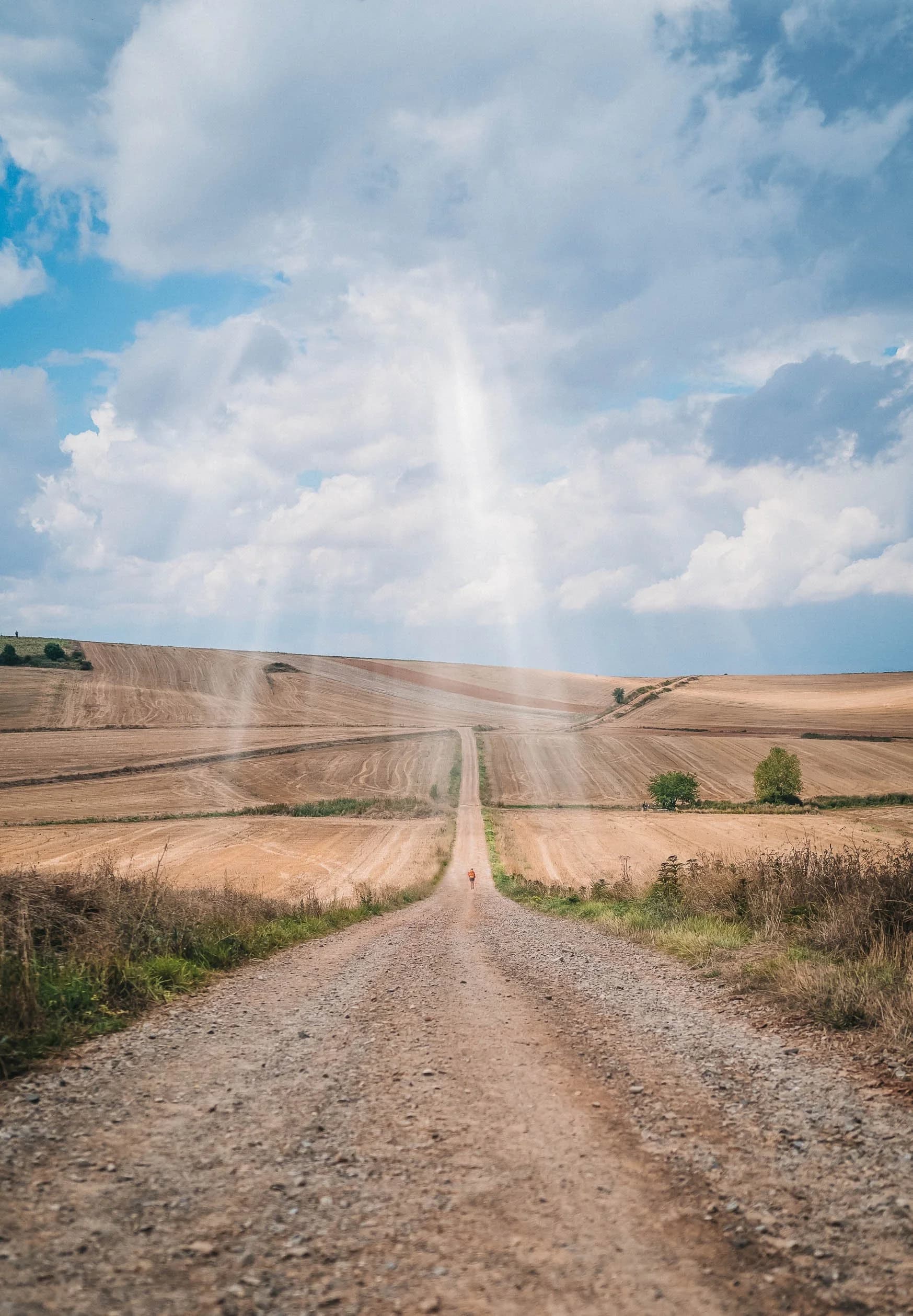
One practical technique that's helped me: on difficult mental days, I pick an object ahead of me—a tree, a building, a particular rock—and tell myself I only have to make it there. Then I pick another. Breaking the journey into tiny, manageable chunks takes it from overwhelming to achievable. It feels almost embarrassingly simple, but it works.
Day eight, coming down from the Cruz de Ferro, I rolled my ankle badly. Not broken, but badly sprained. I spent three days resting in Molinaseca, watching other pilgrims walk past, feeling like the universe was personally punishing me for some unknown sin.
When I finally started walking again, I was slower. Different. Behind the group I'd been walking with. I had to rebuild everything—my pace, my confidence, my social connections.
It was also, looking back, when my Camino became meaningful.
Setbacks strip away the performance aspect of pilgrimage. When you're limping, you can't pretend you're doing this because you're some kind of badass adventurer. You're just a humble human, walking as best you can. That's actually the whole point.
The mental preparation here is simple but not easy: decide in advance that you will not let setbacks end your Camino unless you are genuinely unsafe. Decide that injury, illness, bad weather, emotional crisis—these are all part of the journey, not interruptions to it.
This doesn't mean pushing through serious injury (don't be stupid—if a medical professional tells you to stop, listen). But it means building mental resilience before you need it, so when the moment comes, your default is adaptation rather than defeat.
I've known pilgrims who turned back after one bad day. I've also known pilgrims who walked to Santiago on stress fractures they should have rested. Neither extreme serves you well. The middle path is recognizing that discomfort is not emergency, whilst also respecting genuine limits.
But you can practice getting there before you leave.
Here's what I mean: the pilgrim mindset is fundamentally about letting go of control. Not forcing outcomes. Accepting what the day brings. This is the opposite of how most of us live our regular lives, where we're constantly managing, optimizing, controlling.
The Via Podiensis taught me this more than any other route. Walking through France, language barriers and different customs forced me to accept uncertainty in ways the Spanish routes (where I'd become comfortable) didn't. I couldn't plan perfectly because I couldn't always understand what was being explained to me. I had to trust that things would work out—and they did, usually in unexpected ways.
My suggestion is to start practicing acceptance now, in small ways. Let someone else choose the restaurant. Take a different route to work. When something doesn't go as planned, notice your mental reaction. Do you resist? Can you choose to accept instead?
There's also a practice I find helpful, which is starting each day without an agenda. This sounds impossible in normal life, but try it on a weekend morning. Wake up and simply see what happens. Don't check your phone for the first hour. Let the day unfold. This is good training for the Camino, where your only job is to walk and arrive somewhere by evening.
This can feel terrible whilst it's happening. I spent an entire day between Sahagún and León crying about my grandmother, who had died three years earlier—grief I thought I'd handled. The meseta has a way of doing that. All that flat emptiness just... opens you up.
But this is actually why many people walk the Camino. It's a feature, not a bug. The difficult emotions that surface are ones that needed attention. The Camino just creates conditions where you can't avoid them anymore.
My advice: don't be afraid of this. Welcome it, even. If you feel tears coming, let them come. If old anger surfaces, acknowledge it. You're not breaking down; you're processing. There's a difference.
That said, if you're currently in acute mental health crisis or dealing with recent severe trauma, please work with a professional before attempting a long-distance walk. The Camino can be therapeutic, but it's not therapy. Know the difference.
Start a simple meditation practice. I know, I know—everyone says this. But even five minutes daily of sitting quietly and noticing your breath will help enormously. You don't need an app (though Headspace or Calm work fine). Just sit, breathe, notice when your mind wanders, gently return to the breath. This exact skill—noticing mental wandering and redirecting attention—is what you'll use constantly on the Camino.
Keep a journal before you leave. Write about your motivations, your fears, your hopes for the journey. Not because you'll look back at it (though you might), but because the practice of reflection before walking makes reflection whilst walking feel natural.
Have a mantra ready. Mine is embarrassingly simple: "Just keep walking." When everything feels impossible, I repeat it silently. Step, just keep walking. Step, just keep walking. A small journal is perfect for jotting down thoughts and mantras that help you through difficult moments.
Create a mental "toolbox." Think of three memories that always make you smile. Know three things you can do to shift your mood (walking faster, singing, stopping to photograph something). Have three topics you can think about when you need mental occupation. When a dark mental state hits—and it will—you'll have resources.
Practice being uncomfortable. Take cold showers. Sleep on the floor for a night. Skip a meal. Walk in the rain when you'd rather not. These small voluntary discomforts build mental resilience and teach your brain that discomfort doesn't equal danger. A good silk sleeping bag liner can make uncomfortable sleeping situations more bearable, but the mental acceptance matters more than the physical comfort.
The unique thing about Camino relationships is their depth and brevity. You might walk with someone for three hours, share your deepest fears and hopes, and never see them again. Or you might meet someone on day two and walk with them to Santiago. You can't predict or control it.
But go in knowing that these connections will happen. Be open to them. Don't hide in your headphones (though audiobooks have their place—just not all day, every day). The person walking next to you might be dealing with exactly the same mental challenge, and talking about it helps both of you.
On my Norte journey, I was struggling badly around day ten. Exhausted, lonely despite being surrounded by people, questioning why I was doing this. An older Belgian woman named Marie noticed and simply walked with me in silence for an hour before gently asking what was wrong. That conversation—with a stranger I'd never met before and have never seen since—changed something fundamental in how I approached the rest of the walk.
If you need help planning your Camino in a way that supports your mental preparation, that's a great place to start.
That's the pilgrim mindset. That's what you're preparing for.
It won't last—nothing does. But once you've touched it, you can find your way back. And that ability to return to presence, to acceptance, to just walking—that's what you carry home with you.
The mental preparation isn't about eliminating difficulty. It's about building the capacity to meet difficulty with grace. It's about knowing that the hard parts are part of it, not separate from it. It's about trusting that you can handle whatever the Camino brings—because you can.
Tell the people you love that you might be out of contact more than expected. Not because you won't have phone service (you will, mostly), but because you might need to disconnect mentally. Give them—and yourself—permission for that.
And finally: trust that you're ready. Not because you've prepared perfectly (no one ever does), but because the Camino will meet you where you are. It's been transforming pilgrims for a thousand years, most of whom had far less preparation than you do.
Your legs will carry you. Your mind just needs to let them.
Buen Camino. And truly—reach out if you need to ask about specific mental preparation strategies for particular stages or situations. The hardest part is starting. Once you do, everything else becomes just one step after another.
---
Try asking My Camino Guide:
- What are the most mentally challenging sections of the Camino Frances?
- How do I handle loneliness on the Camino if I'm walking solo?
- What should I do if I want to quit mid-Camino?
Six Camino Frances journeys later, plus the Via Podiensis twice (once all the way through to Santiago), the Norte, both Portuguese routes, and more trips to Finisterre than I care to admit, I can tell you this with absolute certainty: the Camino is maybe 40% physical and 60% mental. And that's being generous to the physical side.
Your legs will adapt. Your blisters will heal. But your mind? That's where the real work happens.
Why Mental Preparation Matters More Than You Think
Here's the thing about walking 500+ miles—it's not actually that hard physically, provided you give your body time to adjust. Humans are literally designed for endurance walking. Our ancestors walked for days chasing down prey. Your body remembers how to do this, even if your desk job has made it forget temporarily.But your mind? Modern life has absolutely not prepared it for what the Camino demands.
Think about your daily existence for a moment. Constant stimulation. Phone buzzing. Emails pinging. Netflix autoplay. We've trained our brains to need entertainment and distraction every waking second. Then we drop ourselves into rural Spain with nothing but our thoughts for company and wonder why we feel like we're losing it by day three.
I've watched it happen dozens of times. Strong, fit people—marathon runners, gym enthusiasts, weekend hikers—completely falling apart mentally whilst pilgrims half their fitness level stroll past with peaceful smiles. The difference isn't physical conditioning. It's mental preparation.
Managing Expectations (Or: How to Stop Ruining Your Own Camino)
Let me share a confession that still makes me cringe. On my first Frances, I had built up this elaborate vision of what my Camino would look like. Quiet mornings watching the sunrise over golden wheat fields. Deep philosophical conversations with fascinating strangers. Arriving at each destination feeling tired but fulfilled, journaling by candlelight before a perfect night's sleep.Reality check: Day four found me hobbling into Estella with bloody socks, having spoken to no one except a very confused cow, utterly exhausted but unable to sleep because someone in my dormitory was snoring like a chainsaw. I spent that evening not journaling but crying into a plate of spaghetti whilst questioning every life decision that led me there.
The problem wasn't the Camino. The problem was the absurd expectations I'd built up from Instagram posts and romanticized blog articles.
Go in knowing this: you will have terrible days. Some towns will be ugly. Some albergues will be hellholes. Some pilgrims will annoy you profoundly. The weather will not cooperate. You will feel lonely even when surrounded by people, and claustrophobic even in wide-open spaces. None of this means you're doing it wrong.
My suggestion is to practice what I call "expectation flexibility" before you leave. Instead of visualizing your perfect Camino, try visualizing yourself handling problems gracefully. Picture yourself laughing off a bad meal. Imagine finding peace in a disappointing albergue. See yourself accepting a rainy day without complaint. This mental rehearsal sounds silly, but it genuinely helps.
And please, for your own sanity, stay off the Camino hashtags once you start walking. Nothing will ruin your authentic experience faster than comparing it to someone else's carefully curated highlight reel.
The Solitude Question
People always ask me whether they should walk alone or with others. My answer is: yes.Even if you start with a partner or group, you will spend significant time alone with your thoughts. Even if you start solo, you will find yourself walking with others for stretches. The Camino has a way of giving you exactly the balance you need, though rarely the balance you thought you wanted.
But here's where preparation comes in. If you've spent your entire life avoiding silence and solitude—and most of us have—suddenly having hours alone with your brain can be genuinely destabilizing.
I'd highly suggest practicing before you go. Start small. Take a walk without headphones. Have lunch alone without your phone. Sit in silence for 20 minutes. Notice what happens. Does your mind race? Do you feel uncomfortable? Do you immediately reach for distraction?
These responses won't magically disappear on the Camino. But being aware of them—knowing your patterns—helps enormously.
The first two days of any Camino are the hardest mentally, I've found. Your brain is still in everyday mode, generating to-do lists and worrying about things back home. By day four or five, something shifts. The walking creates a rhythm that quiets the mental chatter. But you have to get through those first rough days to reach that place.
One practical technique that's helped me: on difficult mental days, I pick an object ahead of me—a tree, a building, a particular rock—and tell myself I only have to make it there. Then I pick another. Breaking the journey into tiny, manageable chunks takes it from overwhelming to achievable. It feels almost embarrassingly simple, but it works.
Handling Setbacks (Because They Will Happen)
Let me tell you about my third Frances, the one where everything went wrong.Day eight, coming down from the Cruz de Ferro, I rolled my ankle badly. Not broken, but badly sprained. I spent three days resting in Molinaseca, watching other pilgrims walk past, feeling like the universe was personally punishing me for some unknown sin.
When I finally started walking again, I was slower. Different. Behind the group I'd been walking with. I had to rebuild everything—my pace, my confidence, my social connections.
It was also, looking back, when my Camino became meaningful.
Setbacks strip away the performance aspect of pilgrimage. When you're limping, you can't pretend you're doing this because you're some kind of badass adventurer. You're just a humble human, walking as best you can. That's actually the whole point.
The mental preparation here is simple but not easy: decide in advance that you will not let setbacks end your Camino unless you are genuinely unsafe. Decide that injury, illness, bad weather, emotional crisis—these are all part of the journey, not interruptions to it.
This doesn't mean pushing through serious injury (don't be stupid—if a medical professional tells you to stop, listen). But it means building mental resilience before you need it, so when the moment comes, your default is adaptation rather than defeat.
I've known pilgrims who turned back after one bad day. I've also known pilgrims who walked to Santiago on stress fractures they should have rested. Neither extreme serves you well. The middle path is recognizing that discomfort is not emergency, whilst also respecting genuine limits.
Cultivating the Pilgrim Mindset
There's a specific mental state that experienced pilgrims seem to share. It's hard to describe—something like acceptance, presence, and gentle curiosity all mixed together. It's not something you achieve and then have; it comes and goes, sometimes within the same hour.But you can practice getting there before you leave.
Here's what I mean: the pilgrim mindset is fundamentally about letting go of control. Not forcing outcomes. Accepting what the day brings. This is the opposite of how most of us live our regular lives, where we're constantly managing, optimizing, controlling.
The Via Podiensis taught me this more than any other route. Walking through France, language barriers and different customs forced me to accept uncertainty in ways the Spanish routes (where I'd become comfortable) didn't. I couldn't plan perfectly because I couldn't always understand what was being explained to me. I had to trust that things would work out—and they did, usually in unexpected ways.
My suggestion is to start practicing acceptance now, in small ways. Let someone else choose the restaurant. Take a different route to work. When something doesn't go as planned, notice your mental reaction. Do you resist? Can you choose to accept instead?
There's also a practice I find helpful, which is starting each day without an agenda. This sounds impossible in normal life, but try it on a weekend morning. Wake up and simply see what happens. Don't check your phone for the first hour. Let the day unfold. This is good training for the Camino, where your only job is to walk and arrive somewhere by evening.
The Things That Will Haunt You (In a Good Way)
I need to warn you about something. The Camino has a way of surfacing buried thoughts and unprocessed emotions. With nothing to distract you, all the stuff you've been avoiding will come up. Grief you never fully processed. Relationships you're not sure about. Career dissatisfaction. Life choices. Regrets.This can feel terrible whilst it's happening. I spent an entire day between Sahagún and León crying about my grandmother, who had died three years earlier—grief I thought I'd handled. The meseta has a way of doing that. All that flat emptiness just... opens you up.
But this is actually why many people walk the Camino. It's a feature, not a bug. The difficult emotions that surface are ones that needed attention. The Camino just creates conditions where you can't avoid them anymore.
My advice: don't be afraid of this. Welcome it, even. If you feel tears coming, let them come. If old anger surfaces, acknowledge it. You're not breaking down; you're processing. There's a difference.
That said, if you're currently in acute mental health crisis or dealing with recent severe trauma, please work with a professional before attempting a long-distance walk. The Camino can be therapeutic, but it's not therapy. Know the difference.
Practical Tools for Mental Preparation
Let me give you some concrete things to do before you go:Start a simple meditation practice. I know, I know—everyone says this. But even five minutes daily of sitting quietly and noticing your breath will help enormously. You don't need an app (though Headspace or Calm work fine). Just sit, breathe, notice when your mind wanders, gently return to the breath. This exact skill—noticing mental wandering and redirecting attention—is what you'll use constantly on the Camino.
Keep a journal before you leave. Write about your motivations, your fears, your hopes for the journey. Not because you'll look back at it (though you might), but because the practice of reflection before walking makes reflection whilst walking feel natural.
Have a mantra ready. Mine is embarrassingly simple: "Just keep walking." When everything feels impossible, I repeat it silently. Step, just keep walking. Step, just keep walking. A small journal is perfect for jotting down thoughts and mantras that help you through difficult moments.
Create a mental "toolbox." Think of three memories that always make you smile. Know three things you can do to shift your mood (walking faster, singing, stopping to photograph something). Have three topics you can think about when you need mental occupation. When a dark mental state hits—and it will—you'll have resources.
Practice being uncomfortable. Take cold showers. Sleep on the floor for a night. Skip a meal. Walk in the rain when you'd rather not. These small voluntary discomforts build mental resilience and teach your brain that discomfort doesn't equal danger. A good silk sleeping bag liner can make uncomfortable sleeping situations more bearable, but the mental acceptance matters more than the physical comfort.
The Community Aspect
One thing that will save you mentally: the pilgrim community. Even if you're introverted (I am), the connections you make on the Camino provide essential mental support.The unique thing about Camino relationships is their depth and brevity. You might walk with someone for three hours, share your deepest fears and hopes, and never see them again. Or you might meet someone on day two and walk with them to Santiago. You can't predict or control it.
But go in knowing that these connections will happen. Be open to them. Don't hide in your headphones (though audiobooks have their place—just not all day, every day). The person walking next to you might be dealing with exactly the same mental challenge, and talking about it helps both of you.
On my Norte journey, I was struggling badly around day ten. Exhausted, lonely despite being surrounded by people, questioning why I was doing this. An older Belgian woman named Marie noticed and simply walked with me in silence for an hour before gently asking what was wrong. That conversation—with a stranger I'd never met before and have never seen since—changed something fundamental in how I approached the rest of the walk.
If you need help planning your Camino in a way that supports your mental preparation, that's a great place to start.
The Moment Everything Shifts
I can't tell you when it will happen for you. For me, it's usually somewhere in the second week. There's a morning when you wake up and realize you're not thinking about your regular life anymore. You're not worried about what's happening back home. You're not planning beyond today's walk. You're just... here. Present. Walking.That's the pilgrim mindset. That's what you're preparing for.
It won't last—nothing does. But once you've touched it, you can find your way back. And that ability to return to presence, to acceptance, to just walking—that's what you carry home with you.
The mental preparation isn't about eliminating difficulty. It's about building the capacity to meet difficulty with grace. It's about knowing that the hard parts are part of it, not separate from it. It's about trusting that you can handle whatever the Camino brings—because you can.
Before You Go
Spend time with your intentions. Why are you walking? You don't need a perfect answer, but you need honest reflection. Write it down. The clearer you are about your "why," the easier the hard days become.Tell the people you love that you might be out of contact more than expected. Not because you won't have phone service (you will, mostly), but because you might need to disconnect mentally. Give them—and yourself—permission for that.
And finally: trust that you're ready. Not because you've prepared perfectly (no one ever does), but because the Camino will meet you where you are. It's been transforming pilgrims for a thousand years, most of whom had far less preparation than you do.
Your legs will carry you. Your mind just needs to let them.
Buen Camino. And truly—reach out if you need to ask about specific mental preparation strategies for particular stages or situations. The hardest part is starting. Once you do, everything else becomes just one step after another.
---
Try asking My Camino Guide:
- What are the most mentally challenging sections of the Camino Frances?
- How do I handle loneliness on the Camino if I'm walking solo?
- What should I do if I want to quit mid-Camino?